
One car tint advertises 95% IRR. Another promotes
high TSER. Then you see VLT, UV rejection,
nano ceramic and sputter technology. Which specification actually matters?
This guide explains how to understand automotive tint specifications
before choosing window film for Malaysia’s hot driving conditions.
Quick Answer: IRR vs TSER vs VLT
IRR describes infrared rejection,
TSER describes total solar energy rejected,
and VLT describes how much visible light passes
through the glazing.
If your goal is a cooler and more comfortable vehicle,
do not compare car tint using IRR alone.
Look at IRR, TSER, VLT, UV protection, optical clarity,
film technology and installation quality together.
IRR
Infrared Rejection
Indicates how effectively a film rejects infrared energy
within the range used for its test.
TSER
Total Solar Energy Rejected
A broader measurement of how much total solar energy
the glazing system rejects.
VLT
Visible Light Transmission
Indicates how much visible light can pass through
the glass-and-film combination.
Choosing automotive window tint should be simple, but the specifications
used in tint advertising can make the decision more confusing
than necessary.
You may see one film promoted using a very high IRR figure,
while another highlights TSER, VLT, UV rejection or advanced
nano ceramic technology.
For drivers in Malaysia, the real question is not simply
“Which tint has the biggest number?”
A better question is:
Which combination of heat control, visibility, UV protection
and film quality is suitable for my vehicle and daily driving?
Understanding IRR, TSER and VLT gives you a better starting point
when comparing automotive window tint.
What Is IRR in Car Tint?
IRR commonly refers to Infrared Rejection.
Infrared energy forms part of the solar energy reaching your vehicle.
Automotive window film designed to reject infrared energy can help
reduce the amount of infrared radiation passing through the glass.
This can contribute to improved cabin comfort, particularly when
driving under strong Malaysian sunlight or after a vehicle has been
exposed to the sun for an extended period.
A higher advertised IRR percentage does not automatically mean
the film is better in every way.
IRR relates specifically to infrared rejection.
It does not by itself tell you everything about total solar performance,
visible-light transmission, night visibility, optical clarity,
durability or installation quality.
When comparing different films or brands, it is sensible to compare
specifications measured under equivalent testing conditions.
An isolated IRR figure should not be the only reason you choose
one window film over another.
What Is TSER?
TSER means Total Solar Energy Rejected.
TSER provides a broader way of looking at the solar-control performance
of automotive glazing because it considers the total solar energy
rejected by the glass-and-film system.
When products are compared under similar testing conditions,
a higher TSER generally indicates that a greater proportion
of incoming solar energy is being rejected.
Why TSER Matters in Malaysia
Malaysian vehicles regularly experience:
- Strong tropical sunlight
- High daytime temperatures
- Outdoor parking
- Long periods in traffic
- Daily urban commuting
- Strong afternoon sun through windscreens and side windows
For this reason, looking at overall solar-control performance
makes more sense than focusing only on how dark the tint appears.
What Is VLT in Car Tint?
VLT means Visible Light Transmission.
VLT represents the percentage of visible light that passes
through the glazing system.
More Light Passes Through
The glass generally appears lighter and allows more visible light
into the vehicle.
Less Light Passes Through
The glass generally appears darker and allows less visible light
into the vehicle.
VLT is important because it affects visibility, appearance
and legal compliance.
It should not, however, be confused with heat rejection.
A film can appear dark without necessarily having better
overall solar-control performance.
Does Darker Tint Mean Better Heat Rejection?
No. Not necessarily.
This is one of the most common misconceptions about automotive tint.
“The darker the tint, the cooler the car.”
Tint darkness is mainly associated with how much visible light
passes through the glass.
Heat-control performance depends on film technology and overall
solar-control characteristics, not simply its visual darkness.
Two films can look similar from outside while using very different
materials and delivering different performance.
Modern automotive window films can therefore provide strong
solar control without requiring an extremely dark appearance.
Better way to compare tint:
TSER + IRR + VLT + UV protection + optical clarity +
film technology + professional installation.
IRR vs TSER vs VLT: What’s the Difference?
Infrared Rejection
Describes the rejection of infrared energy within the tested range.
Why it matters: Useful when comparing infrared heat-control performance.
Total Solar Energy Rejected
Provides a broader indication of how much total solar energy is rejected.
Why it matters: Useful for understanding overall solar-control performance.
Visible Light Transmission
Describes the amount of visible light passing through the glazing.
Why it matters: Important for appearance, visibility and compliance.
UV Rejection
Describes how effectively the film reduces ultraviolet transmission.
Why it matters: Helps reduce UV exposure to occupants and vehicle interior surfaces.
If cabin comfort is your main priority, avoid selecting a film
simply because one advertisement shows a very high IRR number.
Look at the complete specification and ask your installer
to explain how the film performs as a complete glazing system.
What About UV Rejection?
UV rejection is another important feature to consider
when choosing automotive window film.
Long-term ultraviolet exposure can contribute to ageing
and fading of vehicle interior materials such as:
- Leather seats
- Dashboard surfaces
- Interior trim
- Upholstery
- Plastic components
HAMEL Kepong’s current tinting range lists
99% UV rejection across its tint packages,
while IRR and TSER specifications vary depending on the
package and film technology.
For current package specifications, visit our
car tinting in Kepong service page.
HAMEL Kepong Tint Consultation
Not Sure Which Tint Specification Is Right for Your Car?
Tell our Kepong team your car model, driving habits and preferred
level of heat protection. We can help you compare suitable HAMEL
tint options before installation.
What VLT Is Allowed for Private Cars in Malaysia?
VLT is especially important in Malaysia because automotive glazing
must comply with applicable JPJ requirements.
For Malaysian private motor vehicles under the VLT rules introduced in 2019:
Front Windscreen
Minimum visible light transmission requirement for the front windscreen.
Front Side Windows
Minimum visible light transmission requirement for the front
driver and passenger side windows.
Rear-Side Windows
Darker glazing is permitted for private vehicles,
subject to applicable requirements.
Rear Windscreen
Darker glazing is permitted for private vehicles,
subject to applicable requirements.
Important:
Legal compliance depends on the resulting vehicle glazing,
not simply the percentage printed on a roll of tint film.
The vehicle’s original glass and the installed film work together
as the final glazing system.
Regulations can also differ for other vehicle categories,
and approved exemptions may have separate requirements.
Always confirm the appropriate configuration for your vehicle
before installation.
Official reference:
Ministry of Transport Malaysia – VLT Regulations.
Nano Ceramic vs Sputter Tint: Does Technology Matter?
Yes. Film technology can influence solar-control performance,
optical clarity, durability, appearance and overall driving comfort.
Nano Ceramic Tint
Nano ceramic automotive films are commonly selected by drivers
looking for a combination of solar control, UV protection and good
optical clarity without relying simply on extremely dark film.
Nano Ceramic Sputter Tint
More advanced film constructions can use sputtering and multi-layer
technologies to achieve higher levels of solar-control performance
while maintaining usable visibility.
HAMEL Kepong’s current tint range includes nano ceramic,
nano ceramic sputter and multi-layer nano ceramic technologies
across different package levels.
The best film is not automatically the most expensive or the darkest one.
It is the film that gives your vehicle the right balance of
comfort, visibility, solar control, budget and driving needs.
How to Choose the Right Car Tint in Malaysia
Before deciding on a tint package, consider these six practical questions.
How Often Is Your Car Parked Outdoors?
A vehicle regularly exposed to direct sunlight may benefit more
from stronger overall solar-control performance.
How Much Driving Do You Do at Night?
Good visibility remains important at night, during heavy rain
and inside darker car parks.
How Important Is Cabin Heat Reduction?
Compare the film’s overall specifications rather than making
your decision using IRR alone.
How Much Privacy Do You Want?
Your preferred appearance should be balanced with visibility
and applicable VLT requirements.
What Film Technology Are You Comparing?
Compare nano ceramic, sputter and multi-layer options
using equivalent specifications where possible.
What Is Your Budget?
Choose a package based on the performance that matters
to your daily use instead of automatically selecting
the highest specification available.
7 Things to Check Before Paying for Car Tint
- Ask for the film’s IRR specification.
- Ask for its TSER performance.
- Confirm suitable VLT for each window position.
- Check the UV rejection specification.
- Ask what film technology is being installed.
- Confirm warranty period and warranty coverage.
- Choose an installer with proper preparation and workmanship.
This checklist helps you compare car tint packages based on
practical requirements instead of marketing claims alone.
Why Professional Car Tint Installation Matters
Even premium automotive window film can give disappointing results
when installation quality is poor.
Installation problems can include:
- Dust trapped underneath the film
- Visible contamination
- Air bubbles
- Poor edge finishing
- Film lifting
- Uneven cutting
- Optical distortion
Correct glass preparation, suitable installation conditions,
precision cutting and experienced workmanship are therefore
important parts of the final tint result.
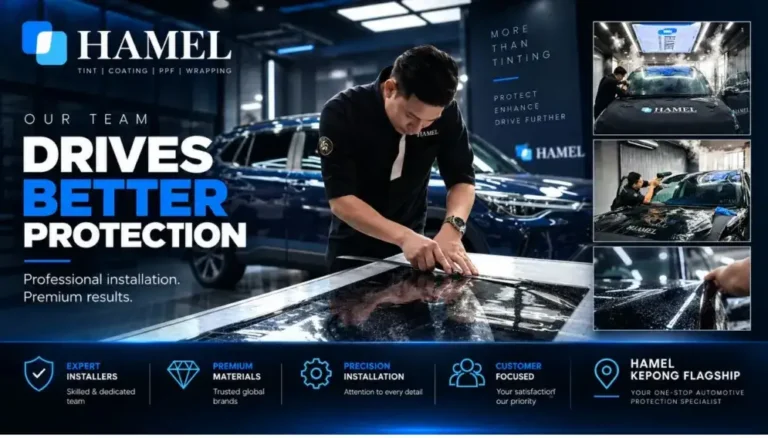
Car Tinting at HAMEL Kepong
At HAMEL Kepong Flagship, our team can help
you compare film technology, IRR, TSER, VLT, visibility and
your preferred level of solar protection before installation.
Current HAMEL tint options include nano ceramic,
nano ceramic sputter and multi-layer nano ceramic technologies
designed for different performance requirements and budgets.
Whether you drive a daily commuter, sedan, SUV, MPV,
EV or premium vehicle, the objective should be the same:
Choose automotive tint that delivers the right balance
of driving comfort, visibility, solar protection,
appearance and professional installation.
Frequently Asked Questions About IRR, TSER & VLT
Is 95% IRR good for car tint?
A high IRR figure can indicate strong infrared rejection within
the film’s tested range, but IRR alone should not be used to judge
overall tint performance. Compare TSER, VLT, UV protection,
film technology, visibility and installation quality as well.
Is higher TSER better for car tint?
When films are compared under equivalent testing conditions,
higher TSER generally indicates that a greater percentage
of total solar energy is rejected.
Does darker car tint reject more heat?
Not necessarily. Darkness relates mainly to visible light transmission.
Modern automotive films can provide strong solar control without
needing to look extremely dark.
What does VLT mean in car tint?
VLT means Visible Light Transmission. It describes how much visible
light passes through the glazing and is important for visibility,
appearance and regulatory compliance.
Which is more important: IRR or TSER?
IRR and TSER describe different aspects of tint performance.
IRR focuses on infrared rejection while TSER provides
a broader measurement of total solar-energy rejection.
They should be considered together with VLT, UV protection
and film quality.
What VLT is allowed for private cars in Malaysia?
For Malaysian private vehicles, the front windscreen requires
at least 70% VLT and the front-side glazing beside the driver
requires at least 50% VLT under the applicable rules.
Different provisions apply to rear glazing and certain vehicle
categories or approved exemptions.
Does film VLT alone determine JPJ compliance?
No. The final glazing result is influenced by both the vehicle’s
existing glass and the installed film. The finished configuration
should therefore be checked rather than relying only on the film label.
What car tint is suitable for Malaysia?
Look for an appropriate combination of total solar-energy rejection,
infrared rejection, UV protection, suitable VLT, optical clarity,
quality film technology and professional installation.
Is nano ceramic tint suitable for Malaysia?
Nano ceramic tint is commonly selected for Malaysian driving because
it can provide solar control, UV protection and good optical clarity.
Actual performance depends on the individual film specification
and installation quality.
Premium Car Tinting • HAMEL Kepong
Choose Your Tint Based on Performance — Not Just Darkness
Send us your car model and our HAMEL Kepong team can help you compare
available tint packages, film technologies, heat-control specifications
and suitable VLT options.
Visit HAMEL Kepong Flagship
HAMEL Kepong Flagship
10, Jalan Kepong Usaha 2,
Kawasan Perusahaan Kepong,
52000 Kuala Lumpur,
Wilayah Persekutuan Kuala Lumpur
WhatsApp: +60 17-549 5496
Information note: Tint specifications can vary by product, glass type and testing method.
Vehicle regulations may also be updated. Always confirm current
product specifications and applicable JPJ requirements before installation.